
Your stock count says 40 units. The shelf has 31.
That gap is what happens when warehouse management runs on memory and spreadsheets instead of a system. Every Singapore seller hits it eventually, usually right before a 9.9 or 11.11 campaign when it hurts the most.
What Does Managing a Warehouse Involve?
Managing a warehouse means controlling four things: where stock sits, how accurately you count it, how fast staff can pick and pack it, and how that data syncs back to Shopee SG, Lazada SG, and TikTok Shop SG. Get any one of those wrong and orders slip, oversell, or ship late.
For a Singapore ecommerce seller, warehouse management is not a separate department. It is usually one person, a spare room or a rented unit, and a system that either scales with order volume or breaks under it.
The four core functions:
- Storage and layout: where each SKU physically lives, and how fast a picker can reach it
- Receiving: logging new stock in accurately the moment it arrives from a supplier
- Picking and packing: pulling the right SKU, in the right quantity, for every order
- Stock accuracy: counting regularly enough that your system count matches the shelf count
Get storage and receiving right, and picking speeds up. Get picking right, and stock accuracy holds. Miss any one function and the others degrade with it, which is why warehouse problems tend to show up as a cluster, not a single issue.
How Do You Organize a Warehouse for Multi-Channel Selling?
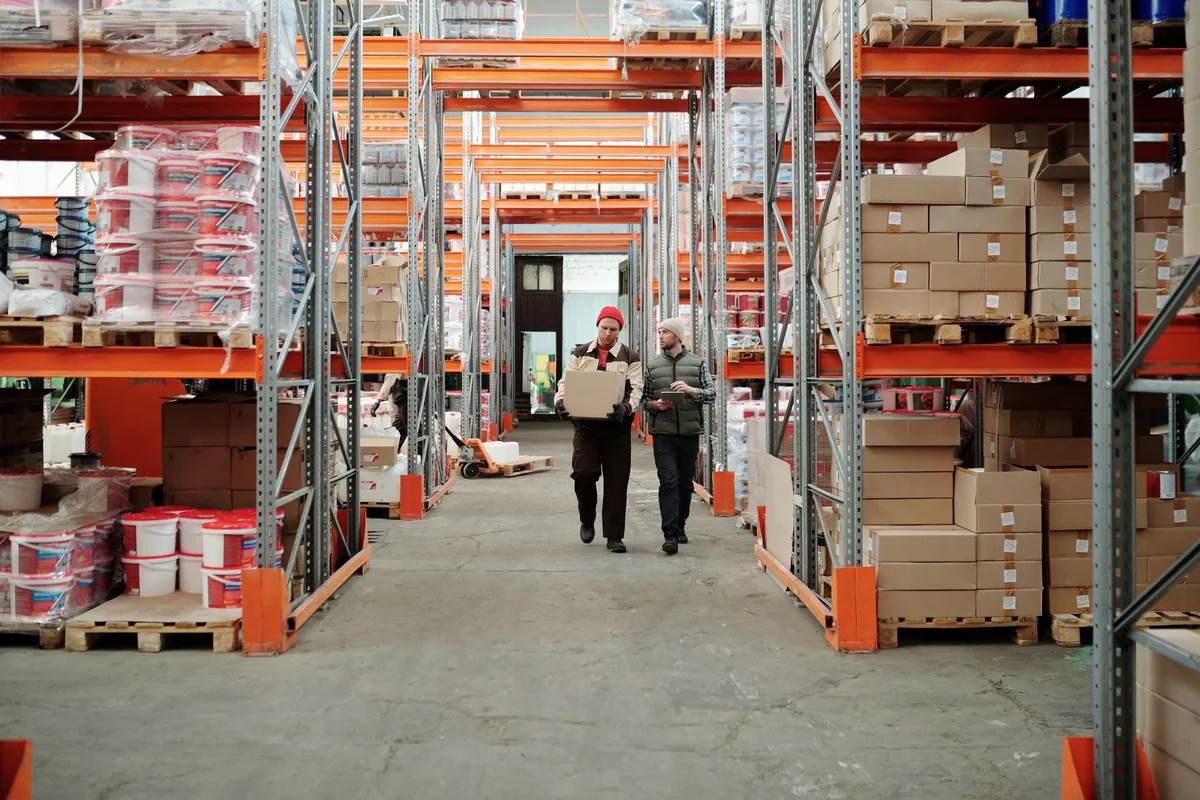
Organize by SKU velocity, not by marketplace or supplier. Fast-moving SKUs go closest to the packing bench, every bin gets a fixed location code, and each code maps to one SKU only. GS1 Singapore’s location-coding standards are a reliable starting point if you are setting bin codes for the first time.
Most sellers default to organizing stock by supplier or by product category. That works until order volume climbs and pickers start walking the length of the warehouse for your best-selling SKU because it landed wherever there was space when it arrived.
A velocity-based layout fixes that:
- A-zone (closest to packing): your top 20% of SKUs by order frequency
- B-zone (mid-aisle): steady but slower-moving stock
- C-zone (back of warehouse): slow movers, seasonal stock, overstock
Within each zone, one bin holds one SKU. No mixed bins, no “it’s somewhere in that section.” A picker with a location code should find any SKU in under 30 seconds without asking a colleague.
This layout matters more in Singapore than in larger markets, because warehouse footprints here tend to be small given local rent costs. A tight, well-zoned space of 500-1,000 square feet can outperform a poorly organized unit twice the size.
How Do You Keep Warehouse Stock Counts Accurate?
Barcode or QR scanning during receiving and picking keeps stock counts accurate, because it removes manual data entry as a source of error. Sellers who scan every unit in and out report fewer discrepancies than those relying on manual tallies, according to seller community reports shared across Singapore ecommerce forums.
Stock accuracy is the single metric that determines whether every other warehouse process works. If your system count does not match your shelf count, your OMS oversells, your safety stock buffers are meaningless, and every reorder decision is a guess.
Three habits protect accuracy:
Scan on receipt. Every unit gets scanned into the system the moment it arrives, not batched for later entry. Delayed logging is where most discrepancies start.
Scan on pick. Scanning the SKU during packing, not just printing the shipping label, confirms the right item left the shelf. This single step catches most mispicks before they become a customer complaint.
Count on a schedule, not a hunch. A monthly full count plus weekly cycle counts on your fastest 20% of SKUs catches drift before it compounds. Waiting for a customer complaint to trigger a count means you are already behind.
Our reorder point calculator and safety stock calculator both depend on accurate counts as an input. Inaccurate stock data feeds inaccurate reorder timing, which is how sellers end up either stocked out or sitting on dead capital.

| Approach | Typical Monthly Cost (SGD) | Order Volume Fit | Who Manages Stock |
|---|---|---|---|
| Spreadsheet + manual counts | S$0 | Under 50 orders/month | You, part-time |
| WMS app (Ginee, Sellercraft) | S$30-150 | 50-1,000 orders/month | You or 1 warehouse staff |
| 3PL outsourced warehousing | S$300-1,500+ (storage plus pick and pack fees) | 200+ orders/month, or want to skip warehousing entirely | 3PL provider staff |
Cost ranges based on publicly listed plans and seller community reports. Actual costs vary by SKU count, storage volume, and service level.
Losing track of what’s actually on your shelves? Check where your warehouse operations stand using the free scorecard below. Five minutes. No cost. No obligation.
Should You Manage Your Own Warehouse or Use a 3PL in Singapore?
Self-managed warehousing gives full control over layout, staffing, and process, but Singapore’s industrial rents are among the highest in Southeast Asia per JTC Corporation’s published data. A 3PL usually costs less below roughly 200-300 orders per month, since you are not paying for space and staff you are not fully using.
This is the decision most growing Singapore sellers face within their first year. There is no universal right answer, but the volume threshold is a reliable guide.
Managing your own warehouse makes sense when:
- You need same-day changes to picking process or packaging
- Your SKUs need special handling (fragile, temperature-sensitive, oversized)
- Your order volume justifies the fixed cost of space and staff
- You want direct control over quality checks before dispatch
A 3PL makes sense when:
- Order volume is inconsistent or still growing
- You want to avoid a lease commitment while validating demand
- You are expanding into Malaysia, Indonesia, or the Philippines and want warehousing without opening a second physical site
- Peak-season volume (9.9, 11.11, 12.12) would require temporary staff you cannot manage in-house
Many Singapore sellers start with a 3PL by necessity, since home-based or small self-managed setups run out of room quickly given typical Singapore residential and industrial space constraints. Moving to a self-managed warehouse later, once volume justifies it, is a normal progression rather than a sign the 3PL choice was wrong.
What Software Helps You Manage a Warehouse in Singapore?
A dedicated WMS or combined OMS/WMS platform replaces spreadsheets once you are selling across two or more channels. Ginee, Anchanto, and Sellercraft all support Shopee SG and Lazada SG stock sync, pushing updates to every connected channel within minutes of a sale rather than requiring manual updates per platform.
Software is not a requirement for a one-person, single-channel operation doing a handful of orders a day. It becomes one the moment you add a second marketplace or hire your first warehouse staff member.
What to look for:
Multi-channel stock sync: the platform pushes stock changes to Shopee SG, Lazada SG, and TikTok Shop SG automatically, not on a manual refresh.
Bin-level location tracking: the system tracks not just how many units you have, but where they physically sit in your warehouse.
Barcode scanning support: either a dedicated scanner or a phone-camera scan option, so receiving and picking do not depend on manual data entry.
Low-stock alerts: automatic flags when a SKU crosses its reorder point, rather than discovering a stockout after a customer order fails.
An order management system and a warehouse management system solve different problems. An OMS manages the order from purchase to delivery. A WMS manages what happens physically inside your four walls. Several platforms popular with Singapore sellers, including Ginee and Anchanto, combine both in one subscription.

What Are Common Warehouse Management Mistakes to Avoid?
The most common warehouse management mistakes for Singapore sellers are skipping cycle counts, letting fast-moving SKUs sit far from the packing station, and updating stock manually across marketplaces instead of syncing automatically. Each mistake compounds the others as order volume grows.
Counting once a year instead of on a schedule. An annual count feels efficient but gives discrepancies twelve months to compound. By the time you find the gap, you cannot trace which order, which supplier delivery, or which mispick caused it.
Organizing by category instead of velocity. A warehouse organized to look tidy is not the same as one organized to be fast. Your best-selling SKU belongs closest to the packing bench, regardless of what product category it falls under.
Manually updating stock across marketplaces. Waiting until end of day to update Lazada SG and TikTok Shop SG after a Shopee SG sale is how sellers oversell during 9.9 and 11.11 campaign windows, when sync speed matters most.
Outgrowing a space and staying anyway. A warehouse that was right-sized at 100 orders a month becomes a bottleneck at 500. Reassess your space and staffing every time order volume roughly doubles, not only when problems start.
Frequently Asked Questions
What does managing a warehouse involve for an ecommerce business?
Managing a warehouse means organizing physical stock, receiving and putting away new inventory, picking and packing orders, and counting stock regularly to catch discrepancies. For sellers running Shopee SG, Lazada SG, and TikTok Shop SG, it also means keeping stock levels synced across every channel so the same unit is never sold twice.
How do I organize a small warehouse for multiple marketplaces?
Group stock by SKU velocity, not by marketplace. Keep fast-moving SKUs near the packing station, assign each bin a fixed location code, and label shelves so any staff member can find stock without asking. A one-SKU-per-bin system prevents most of the picking errors that lead to marketplace order cancellations.
Should I manage my own warehouse or use a 3PL in Singapore?
Self-managed warehousing gives more control but costs more, since Singapore’s industrial rents rank among the highest in the region per JTC Corporation data. Most sellers under roughly 200-300 orders per month find a 3PL cheaper than leasing space and hiring staff. Above that volume, an owned warehouse often becomes more cost-effective.
What software do I need to manage a warehouse in Singapore?
At minimum, a shared spreadsheet or a basic app to track SKU locations and stock counts. Once you sell across two or more marketplaces, tools like Ginee, Anchanto, or Sellercraft add real-time stock sync, so a sale on Shopee SG updates available stock on Lazada SG within minutes instead of hours.
How often should I count warehouse stock?
Run a full stock count monthly and cycle counts on your fastest-moving SKUs weekly. Barcode scanning during counts catches more discrepancies than manual tallying, based on seller community reports. Frequent counts on high-velocity items matter more than one large count, since that is where most stock errors start.