
Ecommerce Inventory Management for Indonesian Sellers
Ecommerce inventory management for Indonesian sellers: Ginee, Jubelio, Sellercraft, Anchanto compared. Prevent overselling on Shopee, Lazada, TikTok Shop.

Three stores. One spreadsheet. Zero confidence in your stock numbers.
If you have ever refreshed Shopee Seller Centre and Lazada Seller Center side by side, manually updating quantities after each sale, you already know this system breaks. Ecommerce inventory management replaces that guesswork with centralized stock tracking across every channel, so you stop overselling, stop losing money to dead stock, and stop spending your evenings reconciling spreadsheets. This guide covers what inventory management means for Indonesian multi-channel sellers, the tools that actually work in this market, and how to choose the right approach for your operation.
What Is Ecommerce Inventory Management?
Ecommerce inventory management is the process of tracking, organizing, and controlling product stock across every sales channel and storage location. For Indonesian multi-channel sellers operating across Shopee, Lazada, Tokopedia, and TikTok Shop, it is the system that prevents overselling and eliminates manual stock reconciliation. According to Indonesia’s Ministry of Trade (Kemendag), the country processed over 3.5 billion ecommerce transactions in 2024.
At its core, inventory management covers four functions: stock tracking (knowing exactly what you have), stock sync (keeping counts consistent across channels), reorder management (knowing when to restock and how much), and stock analysis (identifying slow-moving and dead stock before it ties up your capital).
For sellers operating across more than one marketplace, manual inventory tracking is not a minor inconvenience — it is a direct source of lost revenue and customer complaints.
But knowing you need better inventory management and knowing which approach fits your business are two different problems.
Why Does Inventory Management Matter for Indonesian Sellers?
Indonesian sellers running 2+ marketplaces without inventory software face overselling events during campaign periods like 12.12 and Harbolnas, resulting in order cancellations, Shopee and Lazada penalty points, and potential store suspension. The root cause: each marketplace dashboard tracks stock independently with no cross-platform communication.
Picture this: you run two Shopee stores and one Lazada store from a single warehouse in Jakarta. Your best-selling product has 15 units left. A buyer on Shopee Store A purchases 8 units. You update Store A’s stock to 7, then switch tabs to update Lazada — but before you can, Lazada sells 10 units. You now owe 3 customers products that do not exist.
This is not an extreme example. Based on seller community discussions on Kaskus and in Indonesian Shopee seller groups on Facebook, overselling during normal sales days (not even flash sales) is one of the most common operational problems for multi-channel sellers.
Indonesia’s marketplace landscape amplifies the problem. Sellers here commonly operate across five platforms — Shopee, Lazada, Tokopedia, TikTok Shop, and Bukalapak — each with its own seller dashboard, its own stock management interface, and its own update delay. Add the complexity of cash-on-delivery (COD) orders tracked by Bank Indonesia, where stock is reserved but payment is not confirmed until delivery, and inventory management becomes exponentially harder than in markets with simpler payment flows.

The right inventory system eliminates most of this pain. But the wrong tool — or no tool at all — guarantees that the problem gets worse as you scale.
How Does Multi-Channel Stock Sync Work for Indonesian Sellers?
Multi-channel stock sync connects each marketplace account to a central inventory database via API. When an order is placed on Shopee, the system decreases the central stock count and pushes the updated number to Lazada, Tokopedia, and TikTok Shop within minutes. Sync speed is the critical variable: tools like Ginee and Anchanto advertise under 2-minute sync, per their official platform documentation.
Not all sync tools are equal. Based on official platform documentation and seller reviews, Ginee and Anchanto advertise real-time sync (under 2 minutes), while Jubelio offers real-time sync on higher-tier plans and 5-15 minute intervals on basic plans. Sellercraft provides near-real-time sync with occasional delays reported during peak marketplace traffic.
For sellers managing stock across multiple warehouses — common for sellers serving both Jakarta and Surabaya, or those using marketplace fulfillment centers alongside their own warehouse — look for tools that support multi-location inventory: tracking not just total stock, but stock per warehouse.
For a deeper look at how inventory sync connects to order processing, see our guide to ecommerce order management systems.

Which Inventory Management Software Works Best for Indonesian Sellers?
Four platforms dominate the Indonesian market: Ginee (best free entry point), Jubelio (best for sellers who need accounting integration, priced per order at Rp150/order), Sellercraft (mid-market, contact for pricing), and Anchanto (enterprise-grade for 500+ SKUs, contact sales). Ginee’s free tier is the only publicly listed starting point.
Choosing inventory management software for Indonesia means filtering out the majority of tools built for US and European sellers. Here are the platforms with confirmed Indonesian marketplace integrations, based on official documentation and verified seller reviews.
| Tool | Marketplaces | SKU Limit (Entry Plan) | Sync Speed | Starting Price | TikTok Shop | Best For |
|---|---|---|---|---|---|---|
| Ginee | Shopee, Lazada, Tokopedia, TikTok Shop, Bukalapak | 100 orders/mo (free tier) | Real-time | Free | Yes | Small sellers, 2-3 stores |
| Jubelio | Shopee, Lazada, Tokopedia, TikTok Shop, Bukalapak, Blibli | Unlimited | Real-time (standard plan) | Rp150/order | Yes | Mid sellers needing accounting integration |
| Sellercraft | Shopee, Lazada, Tokopedia | 300 SKUs | Near-real-time | Contact for pricing | No | Mid-market sellers |
| Anchanto | Shopee, Lazada, Tokopedia, TikTok Shop, Zalora | Unlimited | Real-time | Contact sales | Yes | Enterprise, 500+ SKUs, multi-country |
A few distinctions worth noting. Ginee’s free tier is the easiest on-ramp for small sellers, but the order cap means you will outgrow it quickly if your business is growing. Jubelio’s accounting integration is a genuine differentiator — Indonesian sellers who need tax compliance (increasingly important with Indonesia’s e-commerce tax regulations) save significant time by having inventory and financials in one system. Anchanto is built for scale and multi-country operations, but the price point makes it impractical for sellers under 500 SKUs.
For Indonesian sellers who prefer reading in Bahasa Indonesia, our panduan aplikasi inventory barang covers the same tools with local pricing and terminology.
For sellers who also need order management and shipping label automation, most of these tools bundle inventory and order management together. The question is whether the inventory features are deep enough for your needs or if they are secondary to the order processing focus.
Still running inventory from spreadsheets? See which tools Indonesian sellers at your scale actually use — read our software inventory comparison for a side-by-side breakdown with local pricing.
How Does TikTok Shop Change Inventory Management for Indonesian Sellers?
TikTok Shop uses the TikTok Shop Open Platform API — not the same open API architecture as Shopee or Lazada. Third-party inventory tools must have certified Open Platform integration for real-time sync. Tools without it rely on slower workarounds, and COD stock holds on TikTok Shop behave differently from other marketplace COD flows.
TikTok Shop is now one of the primary sales channels for Indonesian sellers alongside Shopee, but it behaves differently from other marketplaces when it comes to inventory sync.
The key difference: TikTok Shop Indonesia does not use the same open API architecture as Shopee or Lazada. Third-party inventory tools must integrate via the TikTok Shop Open Platform, which has more restricted data access than the standard Lazada or Shopee seller APIs. This means not all tools that claim “TikTok Shop support” have equally deep integrations — some offer certified API sync, others rely on webhook-based workarounds that are slower and less reliable.
Certified TikTok Shop integrations (as of Q2 2026):
- Ginee — Official TikTok Shop Open Platform partner with real-time stock sync and order management.
- Jubelio — Integrated with TikTok Shop including order pull and inventory push. Included in their standard Rp150/order plan.
- Anchanto — Full TikTok Shop integration with multi-country support (Indonesia and Malaysia TikTok Shop accounts can be managed from one dashboard).
- Sellercraft — Does not currently list TikTok Shop as a supported channel. Sellers who sell on TikTok Shop and Shopee/Lazada will need to manage TikTok Shop stock separately.
COD on TikTok Shop: an extra complication
TikTok Shop Indonesia has a COD variant that works differently from Shopee or Lazada COD. TikTok Shop’s logistics network (TikTok Shop Logistics, formerly known as SFC — Shop Fulfillment Center) handles the COD flow internally, which means the stock hold period can differ from what your inventory tool reports. If your tool integrates with TikTok Shop’s Open Platform directly, it will receive hold status updates via webhook. If it does not, your available stock number on TikTok Shop will lag behind actual inventory levels — leading to overselling during campaign periods.
Practical implication: If you sell on TikTok Shop, verify before choosing an inventory tool that it has a certified TikTok Shop Open Platform integration, not just a listing claim. Ask specifically: does the tool sync stock holds (not just completed orders) from TikTok Shop in real time?
How Do You Manage Dead Stock, Safety Stock, and Reorder Points?
Dead stock — inventory unsold for 60-90 days depending on product category — is the silent profit drain most Indonesian sellers ignore. The fix is systematic: set a reorder point per SKU using the formula (average daily sales × supplier lead time in days) + safety stock buffer. For Indonesian sellers with unpredictable Chinese manufacturer lead times, a 15-20% safety stock buffer is a reasonable starting point.
Dead stock is inventory that has not sold within a defined period. It ties up cash, takes up warehouse space, and often ends up being liquidated at a loss. Based on seller community feedback, the most common causes of dead stock for Indonesian sellers are over-ordering from suppliers (buying 500 units based on one good week of sales), seasonal products that do not sell after the campaign ends, and variant overload (ordering 10 colors when 3 account for 80% of sales).
The fix is systematic: set reorder points and safety stock levels for every SKU.
Reorder point = (average daily sales × lead time in days) + safety stock. If you sell 10 units per day and your supplier takes 7 days to deliver, your reorder point is 70 + safety stock.
Safety stock = a buffer to account for demand spikes and supplier delays. For Indonesian sellers, where supplier lead times from Chinese manufacturers can be unpredictable and domestic logistics during Ramadan and year-end campaigns slow down significantly, a safety stock of 15-20% of your reorder point is a reasonable starting buffer.
Most inventory management tools let you set reorder alerts per SKU. If yours does not, a simple spreadsheet with these formulas is better than nothing.
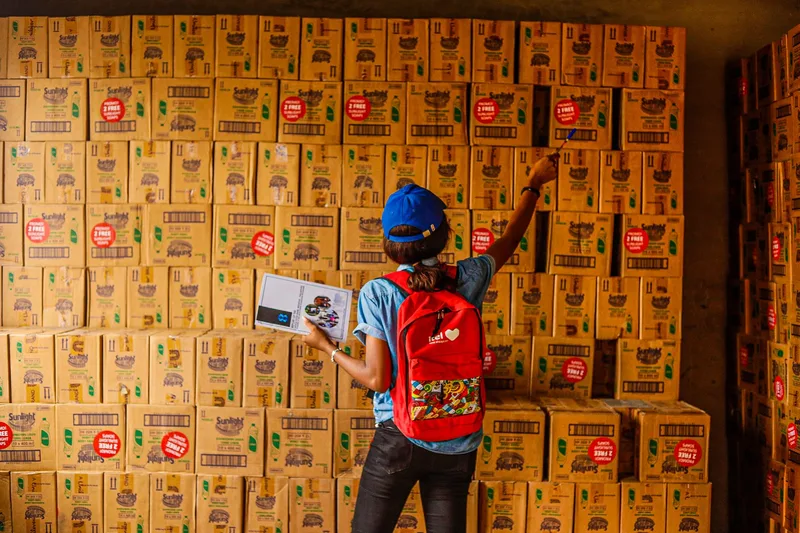
But tracking numbers is only half the challenge — knowing what to do with the data is where most sellers fall short.
How Do You Choose the Right Inventory Management Approach?
Match your approach to three variables: SKU count, channel count, and growth rate. Indonesian sellers with under 100 SKUs on 1-2 stores can manage with free tools or spreadsheets. Sellers on 3+ channels with 200+ SKUs need dedicated inventory software. Those exceeding 500 SKUs with multi-warehouse operations need a full WMS, per Anchanto’s and Jubelio’s published feature comparisons.
The right approach depends on three variables: how many SKUs you manage, how many channels you sell on, and how fast you are growing. Here is a decision framework based on the most common seller profiles in Indonesia.
Profile 1: Starter seller (under 100 SKUs, 1-2 stores)
You do not need dedicated software yet. Use each marketplace’s built-in stock management (Shopee Seller Centre, Lazada Seller Center) and a Google Sheet to track total inventory. This approach breaks down around 100 SKUs or when you add a third channel. Total cost: free.
Profile 2: Growth seller (100-500 SKUs, 2-4 stores)
This is the sweet spot for entry-level inventory tools. Ginee’s free tier (if you are under 100 orders per month) or Sellercraft gives you centralized stock tracking with automatic sync. You need multi-channel sync, basic reorder alerts, and the ability to see all your stock in one view. Check Sellercraft’s current pricing directly on their site. Total cost: free to mid-range depending on tool and order volume.
Profile 3: Scale seller (500+ SKUs, 4+ stores, multi-warehouse)
Evaluate Jubelio or Anchanto. At this scale, you need multi-warehouse tracking, detailed stock movement reports, automated reorder triggers, and integration with your accounting system. Jubelio charges per processed order (Rp150/order per their published pricing page) with unlimited SKUs and channels, which suits high-volume sellers. Anchanto is enterprise-grade with custom pricing — contact their sales team. If you are also managing a physical warehouse with picking and packing operations, you need warehouse management features — not just stock counting.
Before committing, run a 2-week trial with your actual inventory data. Import your full SKU catalog, connect at least two marketplace accounts, and test the sync during a normal sales period — not just during quiet hours.

What Are the Most Common Inventory Management Mistakes Indonesian Sellers Make?
The five most damaging mistakes are: relying on marketplace-native stock tools for multi-channel selling, ignoring dead stock until it fills the warehouse, applying the same stock allocation across all channels regardless of sales velocity, failing to standardize SKUs before connecting a sync tool, and not accounting for COD stock holds — a problem specific to Indonesian ecommerce cash-on-delivery order flows.
Indonesian multi-channel sellers make predictable errors with inventory management. Recognizing them early saves money and frustration.
Relying on marketplace-native stock tools for multi-channel. Shopee Seller Centre and Lazada Seller Center each track stock within their own ecosystem only. They do not talk to each other. Sellers who try to manage multi-channel stock using only platform tools inevitably oversell during busy periods. Once you sell on more than one marketplace, you need a centralized tool or a very disciplined manual process.
Ignoring dead stock until it fills the warehouse. Every SKU that has not sold in 60-90 days (depending on product category) is dead capital. Run a monthly dead stock audit — sort your inventory by last sale date and flag anything older than 60 days for clearance pricing or bundling. Sellers who skip this audit regularly find a significant portion of their warehouse space occupied by products that will never sell at full price.
Setting the same stock levels across all channels. Not every marketplace performs equally for every product. If 70% of your sales for a SKU come from Shopee, allocating stock equally across Shopee, Lazada, and Tokopedia means Shopee frequently runs out while the other channels sit with excess. Allocate stock proportionally to each channel’s sales velocity, and adjust monthly.
Not mapping SKUs before connecting to a sync tool. If your Shopee SKU format is “SHOE-BLK-42” and your Lazada SKU is “BLK42SHOE,” the inventory tool cannot automatically match them. Map and standardize your SKU format across all channels before connecting to any sync tool, or you will spend the first week fixing mismatched products. For related guidance on structuring your order workflows, see our order management system guide.
Forgetting COD stock holds. COD orders reserve stock but do not confirm payment until delivery. If your inventory tool does not distinguish between confirmed sales and COD holds, your available stock numbers are inaccurate. Verify that your chosen tool tracks COD-reserved stock separately — especially during Ramadan and 11.11/12.12 campaigns when COD rates spike.
How Do You Manage Inventory During Campaign Periods (9.9, 11.11, 12.12)?
Campaign periods compress months of inventory risk into a few days. The recommended buffer: increase safety stock for top-selling SKUs to at least 30-40% of your reorder point starting 2-3 weeks before the campaign date, restrict listings on lower-velocity channels during the campaign window, and verify COD stock holds are tracked separately before the campaign opens.
Indonesian campaign periods — Harbolnas (12.12), 11.11, 9.9, and Ramadan flash sales — compress months of inventory risk into a few days. If your stock management is not prepared before the campaign opens, you cannot fix it mid-sale.
Build your safety stock buffer 2-3 weeks in advance. Based on seller community reports across Kaskus and Indonesian Shopee seller groups, campaign periods drive order spikes that can significantly exceed normal daily volume. A recommended buffer for campaign preparation: increase your safety stock from the standard 15-20% of reorder point to at least 30-40% for your top-selling SKUs, starting 2-3 weeks before the campaign date. This is a general best-practice recommendation — your actual buffer should be based on your own historical campaign sales data.
Restrict listings on weaker channels before the campaign opens. If you sell on Shopee, Lazada, and Tokopedia, but 80% of your campaign orders historically come from Shopee, consider temporarily pausing or reducing allocation on Tokopedia and Lazada during the campaign window. This concentrates available stock where it will sell fastest and reduces the risk of overselling across channels when sync speed lags during marketplace traffic spikes.
COD rates spike during campaigns — and so do your stock holds. Based on seller community observations, COD order rates increase significantly during 11.11 and 12.12 compared to normal trading days. Because COD orders reserve stock before confirming payment, a campaign period can inflate your stock hold pool substantially. If your inventory tool does not track COD holds separately from confirmed sales, your real available stock number will appear higher than it is — and you will oversell. Run a pre-campaign audit: log in to your inventory tool 48 hours before the campaign opens and verify that COD-held stock is displayed separately from available-to-sell stock.
Post-campaign inventory reconciliation. After a major campaign period, run a full stock count and reconcile against your inventory tool’s numbers within 48-72 hours. Campaign periods generate returns, failed COD deliveries, and stock adjustments that accumulate faster than on normal days. Sellers who delay reconciliation often carry inflated stock numbers for weeks after a campaign, which leads to overbuying and dead stock in the following month.
Frequently Asked Questions
What is the difference between Ginee and Jubelio for Indonesian sellers?
Ginee and Jubelio serve different seller profiles. Ginee’s main advantage is a free entry tier (limited to 100 orders per month) with real-time sync across Shopee, Lazada, Tokopedia, and TikTok Shop — it is the easiest on-ramp for small sellers. Jubelio’s main advantage is accounting integration: it bundles inventory, order management, and financial reporting in one system, which saves significant time for sellers who need Indonesia’s e-commerce tax compliance. Jubelio uses a per-order pricing model (Rp150/order with unlimited SKUs and channels, per their published pricing page), which makes it more cost-predictable for high-volume sellers but more expensive than Ginee at low order volumes. Start with Ginee if you are under 500 SKUs and do not need accounting. Evaluate Jubelio once your order volume grows or when managing financials separately becomes a bottleneck.
Can I use TikTok Shop with third-party inventory tools?
Yes, but the quality of integration varies. Ginee, Jubelio, and Anchanto all have certified integrations with the TikTok Shop Open Platform, enabling real-time stock sync and order management. Sellercraft does not currently list TikTok Shop as a supported channel. The important distinction is between certified Open Platform integrations (which sync stock holds and completed orders in real time) and looser webhook-based workarounds (which may lag during high-traffic periods). Before choosing a tool, confirm whether it has official TikTok Shop Open Platform certification — not just a listing claim.
How long does it take to set up inventory sync across Shopee and Lazada?
Basic inventory sync between Shopee and Lazada via a tool like Ginee or Jubelio typically takes 1-3 hours of active setup time: creating your account, connecting marketplace API credentials, importing your SKU catalog, and mapping products across channels. The most time-consuming step is SKU mapping — if your product codes differ between Shopee and Lazada (e.g., “SHOE-BLK-42” on Shopee vs “BLK42SHOE” on Lazada), you need to match them manually before sync will work correctly. Plan for a half-day of setup and a 2-week testing period before relying on the sync for high-volume periods.
What happens to my inventory data if I cancel my subscription?
Most inventory tools allow data export before account closure — typically as a CSV containing your SKU catalog, historical stock movements, and order records. Before canceling any subscription, export your full SKU catalog and at least 12 months of stock movement history. Some tools retain your data for a limited period (often 30-90 days) after cancellation; others delete it immediately. Check your platform’s data retention policy before initiating a cancellation. Your marketplace product listings are not affected by canceling your inventory tool — only the sync and centralized tracking will stop.
Is there a free inventory management tool for sellers with multiple warehouses?
Ginee’s free tier supports multi-location inventory tracking (multiple warehouses or fulfillment centers) with a limit of 100 processed orders per month. If you exceed that order cap, you will need a paid plan. Jubelio’s per-order pricing (Rp150/order) scales with volume and includes unlimited store locations — meaning multi-warehouse tracking is included without a separate fee tier. Free-tier tools from Shopee Seller Centre or Lazada Seller Center do not support multi-warehouse tracking or cross-channel sync, which makes them insufficient for sellers running stock from more than one location across multiple marketplaces.
Keep Reading
Inventory management connects directly to order processing and fulfillment. These guides cover the full operational picture for Indonesian sellers.
- Software Inventory for Indonesian Ecommerce Sellers — Compare Ginee, Jubelio, Sellercraft, and Anchanto with local pricing and feature breakdowns
- Ecommerce Order Management Systems — Centralized order processing, shipping automation, and multi-channel workflow
- Ecommerce Fulfillment and 3PL — Third-party logistics, fulfillment centers, and COD logistics for Indonesian sellers
Right now, you might be toggling between browser tabs, manually adjusting stock after every sale, hoping nothing slips through. A month from now, you could have every SKU tracked, every channel synced, and reorder alerts firing before you run out. Start with the guide that matches your biggest inventory headache, and work from there.
Inventory Tracking Programs for Indonesian Sellers
Inventory tracking programs log every stock move and update your Shopee, Tokopedia and Lazada counts. See what they track and which type fits.
Inventory Keeping Software: What It Records in Indonesia
Inventory keeping software records every stock change with a date, reason and user. See what it keeps, what tax rules mean for it and how to start.
Inventory Mgmt Software: How It Works for Indonesian Sellers
Inventory mgmt software keeps one stock count across Shopee, Lazada and TikTok Shop. See how it works, what it costs in Rupiah, and what to check first.
Inventory Mgmt System: A Guide for Indonesian Sellers
An inventory mgmt system keeps one stock count across Shopee, Tokopedia, Lazada and TikTok Shop. See how it works and what it costs in Indonesia.
Inventory Tracking Programs for Indonesian Sellers
Inventory tracking programs log every stock move and update your Shopee, Tokopedia and Lazada counts. See what they track and which type fits.
GuideInventory Keeping Software: What It Records in Indonesia
Inventory keeping software records every stock change with a date, reason and user. See what it keeps, what tax rules mean for it and how to start.
GuideInventory Mgmt Software: How It Works for Indonesian Sellers
Inventory mgmt software keeps one stock count across Shopee, Lazada and TikTok Shop. See how it works, what it costs in Rupiah, and what to check first.
GuideInventory Mgmt System: A Guide for Indonesian Sellers
An inventory mgmt system keeps one stock count across Shopee, Tokopedia, Lazada and TikTok Shop. See how it works and what it costs in Indonesia.
GuideInventory Stock Software: What It Tracks in Indonesia
Inventory stock software keeps one stock count across Shopee, Lazada and TikTok Shop. See what it tracks, how alerts work and how to choose.
GuideSystem Inventory: How It Works for Indonesian Sellers
A system inventory tracks your stock across Shopee, Tokopedia, and Lazada. Learn how inventory systems work and which tools Indonesian sellers use.
GuideSoftware Inventory (Indonesia Sellers)
Compare top software inventory options for Indonesian ecommerce sellers. Features, pricing in IDR, and marketplace sync for Shopee, Tokopedia, and Lazada.
Guide