
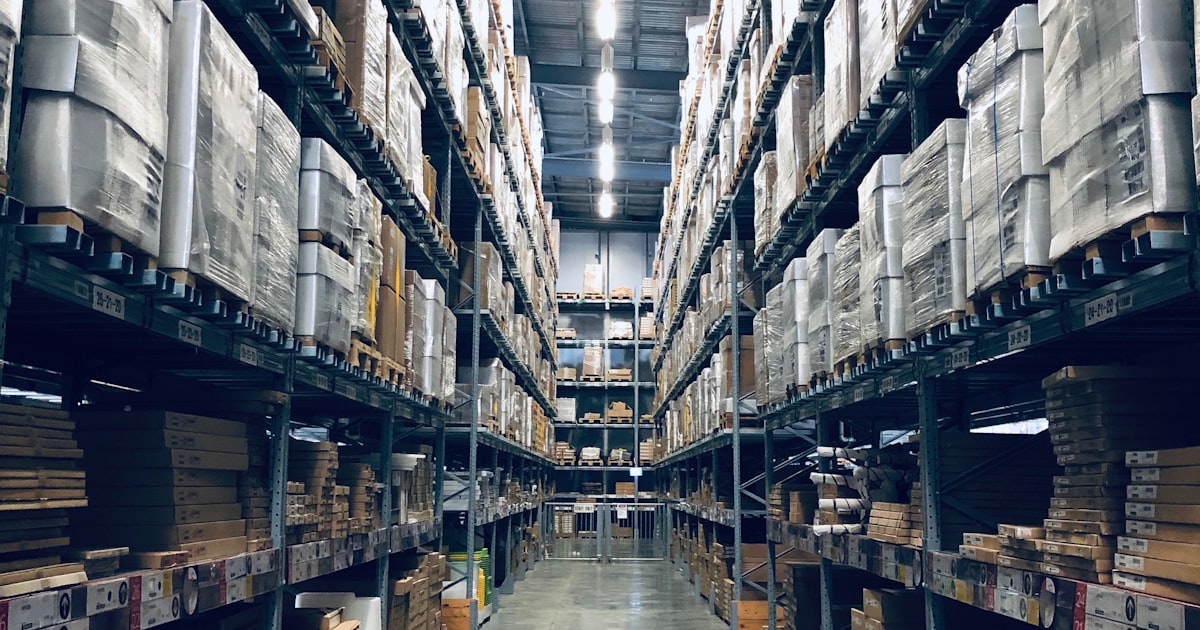
Your warehouse floor is full, but half your vertical space is empty. That is the problem racking solves.
Most ecommerce businesses in Malaysia start with products on the floor or on basic shelving from the hardware store. It works until you hit 200-300 SKUs – then picking slows down, items get buried under newer stock, and you start losing inventory you know you purchased. A proper warehouse racking system turns wasted vertical space into organized, accessible storage that scales with your business.
This guide covers the main types of racking, what each one costs in Malaysia, and how to choose the right system for your operation size.
What Is a Warehouse Racking System?
A warehouse racking system is a structured storage framework made from steel uprights, beams, and decking that holds inventory on multiple vertical levels. Unlike flat shelving, racking is engineered to support heavy loads (typically 500-3,000 kg per level) and is designed for forklift or manual access.
Racking is part of your broader order management system – the physical infrastructure that determines how fast you can receive, store, pick, and ship orders. A well-planned racking layout directly impacts pick speed, accuracy, and warehouse capacity.
According to the Malaysia External Trade Development Corporation (MATRADE), Malaysia’s ecommerce sector grew 16% year-on-year in 2025, driving demand for warehouse infrastructure across Selangor, Johor, and Penang. As order volumes rise, the gap between flat-floor storage and structured racking becomes a throughput bottleneck.
The racking system you choose depends on three factors: what you store, how often you access it, and how much vertical space you have.
Types of Warehouse Racking Systems
Selective Pallet Racking
Selective racking is the most common system worldwide and the default choice for most ecommerce warehouses. Every pallet position is directly accessible from the aisle – no need to move other pallets to reach the one you want.
How it works: Two upright frames connected by horizontal beams, forming bays. Pallets sit on the beams at each level. Aisles between rows allow forklift access.
| Specification | Typical Range |
|---|---|
| Height | 3-8 metres |
| Load per level | 500-2,000 kg |
| Pallet positions per bay | 2-3 (per level) |
| Aisle width required | 2.5-3.5 metres |
| Cost per bay (Malaysia) | RM 300-800 |
Best for: Ecommerce warehouses with 100-1,000 SKUs that need frequent access to every product. If you pick from more than 60% of your SKU range daily, selective racking is the right choice.
Limitation: Uses about 50% of floor space for aisles. If floor space is your constraint, consider denser options below.
Drive-In / Drive-Through Racking
Drive-in racking eliminates aisles by allowing forklifts to drive directly into the rack structure. Pallets are stored 2-6 deep on rails, with the forklift entering from one side (drive-in) or both sides (drive-through).
| Specification | Typical Range |
|---|---|
| Height | 4-10 metres |
| Storage density | 60-80% more than selective |
| Load per lane | 4-8 pallets deep |
| Cost per bay (Malaysia) | RM 500-1,200 |
Best for: Bulk storage of identical items – for example, a seller stocking 500 identical units of a single product. The LIFO (Last In, First Out) access pattern means this is not ideal for perishables or products with expiry dates.
Limitation: Only the front pallet is accessible. If you have 20 SKUs on drive-in racking, picking one SKU from the back means removing everything in front of it first.
Longspan / Boltless Shelving
Not technically “racking” in the industrial sense, but boltless shelving is the most practical option for small ecommerce operations handling items under 50 kg per level.
| Specification | Typical Range |
|---|---|
| Height | 1.8-2.4 metres |
| Load per level | 100-500 kg |
| Assembly | Hand-assembled, no tools |
| Cost per bay (Malaysia) | RM 150-400 |
Best for: Small ecommerce businesses with items that fit in bins or cartons. Fashion, electronics accessories, beauty products, stationery. Combine with bin labels for a low-cost pick-and-pack system.
Limitation: Cannot store pallets. Not suitable for items over 50 kg. Limited height compared to pallet racking.
Cantilever Racking
Cantilever racking uses arms extending from a central column, with no front uprights blocking access. Designed for long, bulky, or irregularly shaped items.
| Specification | Typical Range |
|---|---|
| Height | 3-6 metres |
| Arm length | 0.6-1.5 metres |
| Load per arm | 200-1,500 kg |
| Cost per bay (Malaysia) | RM 600-1,500 |
Best for: Sellers handling pipes, timber, carpet rolls, surfboards, or any product that does not fit standard pallet dimensions. Rare in typical ecommerce but critical for niche product categories.
Flow Racking (Gravity / Carton Flow)
Flow racking uses inclined rollers or wheels so products loaded at the back automatically slide to the front. This creates FIFO (First In, First Out) flow – essential for perishables or date-sensitive products.
| Specification | Typical Range |
|---|---|
| Height | 2-6 metres |
| Depth | 3-8 cartons deep |
| Flow mechanism | Gravity rollers or wheels |
| Cost per bay (Malaysia) | RM 800-2,000 |
Best for: High-volume ecommerce operations with fast-moving SKUs. Also ideal for food, supplements, or beauty products with expiry dates where FIFO compliance matters.
How to Choose the Right Racking System
Use this decision framework based on your operation:
| Your Situation | Recommended Racking | Why |
|---|---|---|
| Under 200 SKUs, items under 50 kg | Boltless shelving | Low cost, easy setup, no forklift needed |
| 200-1,000 SKUs, mixed sizes | Selective pallet racking | 100% access, scalable, industry standard |
| Bulk storage of few SKUs | Drive-in racking | Maximum density for identical items |
| Long/bulky items | Cantilever racking | Only option for oversized products |
| Perishable or date-sensitive products | Flow racking | FIFO compliance built into the structure |
| High-volume pick-and-pack | Selective + carton flow hybrid | Fast picking for top 20% SKUs, selective for the rest |
For most Malaysian ecommerce businesses doing 50-500 orders per day, selective pallet racking combined with boltless shelving is the practical answer. Use pallet racking for bulk storage and replenishment, and boltless shelving in the pick zone for fast-moving items.
Setting Up Racking in Your Malaysian Warehouse
Step 1: Measure and Map Your Space
Before ordering racking, measure your warehouse floor area, ceiling height (usable height, not peak), column positions, door locations, and fire sprinkler clearances. Malaysian warehouses in Selangor industrial parks typically have 6-8 metre clear heights, giving you 3-4 levels of pallet racking.
Draw a floor plan with dimensions. Mark areas for receiving, storage, picking, packing, and shipping. The racking goes in the storage zone – not blocking receiving bays or packing tables.
Step 2: Choose a Racking Supplier
Malaysian racking suppliers include SSI Schaefer, Eonmetall, AR Racking, and several local fabricators. When comparing quotes:
- Get quotes per bay (frame + beams + decking), not per metre
- Ask about load capacity per level and total per bay
- Confirm if installation is included in the price
- Check compliance with MS 2581:2014 (Malaysian Standard for steel storage systems)
- Ask about warranty and structural certification
Step 3: Install and Label
Professional installation typically takes 1-3 days for a small warehouse (under 500 sqm). After installation:
- Label every location with a code (e.g., A-01-03 = Aisle A, Bay 01, Level 03)
- Map locations in your warehouse management system or spreadsheet
- Assign fast-moving products to ground level for picking speed
- Place heavy items at lower levels for safety
Common Mistakes to Avoid
Buying racking before measuring aisle width – a forklift needs 2.5-3.5 metres of aisle space. If your warehouse is 10 metres wide and you install 4 rows of racking with 3-metre aisles, you have used all your space on aisles and gained zero storage. Measure first, then design the layout.
Ignoring weight limits – overloading racking is a safety hazard and a liability issue. Each beam level has a maximum load rating stamped on it. Exceeding it risks structural collapse. This is not theoretical – it happens, and when it does, it destroys inventory and can injure staff.
Not accounting for growth – racking should be modular. Buy a system that lets you add bays and levels incrementally. If you are at 100 orders per day now and expect 300 in 12 months, plan the layout for 300 from day one and install for 100. Leave space for expansion.
Placing slow-moving stock at pick height – ground level and eye level are prime picking real estate. Reserve these for your top 20 SKUs by volume. Put slow movers on upper levels accessed only for replenishment.
Next Steps
A week from now, you could still be stacking boxes on the floor and losing 20 minutes per pick searching for buried inventory. Or you could have a racking system on order that turns your vertical space into organized, labelled storage.
Start by measuring your warehouse and mapping your floor plan. If you are running a WMS, connect your racking locations to your system for real-time inventory tracking – read our guide on warehouse management systems to set that up.
For the full picture on optimising your warehouse operations, explore the order management system hub.